
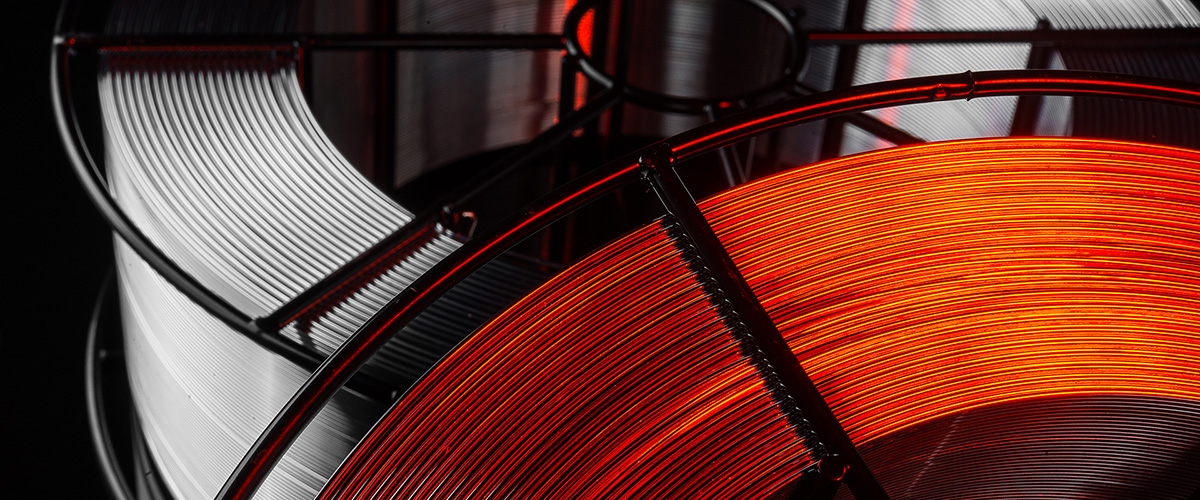
In wire and cable tension control, breaks, stretched conductors, off-center insulation and collapsed packages often trace back to one variable: tension. Whether you make fine wire, insulated conductors or multi-strand cable, tension decides how clean your product runs.
As line speeds rise, manual adjustments can’t keep up. This guide explains where tension goes wrong, zone by zone, and how closed-loop control holds it steady.
WHY TENSION CHANGES ON ITS OWN
Tension is a force, typically measured in newtons (N), pounds-force (lbf) or grams-force (gf). What the wire feels is stress: tension divided by its cross-sectional area. Halve the diameter and the area drops to a quarter, so the same tension produces four times the stress. That is why fine wire is so unforgiving.
Spools add a second problem. Tension equals torque divided by radius. As a payoff spool empties, its radius shrinks, so the same brake torque produces more tension. As a take-up package builds, its radius grows, so the same drive torque produces less. A setting that is right at the start of a run is wrong by the end of it.
Payoff and Unwind
Most tension problems start here. A spool’s inertia resists speed changes: on start-up the wire is snatched, and on a stop the spool overruns and throws slack. Add the rising tension of an emptying spool, and the result is stretch, breaks and tangles that carry downstream.
Wire Drawing
The die sets the diameter; tension decides what happens to the wire on the way through. Back tension and capstan pull both add to the stress the wire carries leaving the die. Push the total toward the material’s tensile limit and the wire stretches, necks down below spec or breaks.

Annealing
Annealing softens the conductor, and hot metal yields at a far lower stress than cold metal. Tension that is harmless at room temperature can permanently stretch wire inside the annealer, reducing its final elongation and pulling it off size. Keep tension low and constant through the annealer.
Stranding and Bunching
Each twisted wire should carry an equal share of the load. A tighter wire pulls to the center of the bundle; a looser one bulges outward. The results: inconsistent lay length, out-of-round strands, bird-caging and loose wires that snag downstream. Independent control on each payoff prevents this.
Insulation Extrusion and Cooling
Extruder output and line speed set insulation thickness, but tension decides where the conductor sits in the crosshead. Too little tension lets the conductor wander, producing off-center insulation and thin walls on one side. Too much stretches a still-warm conductor. Melt drag, shrinkage and cooling-trough water drag add tension that varies with speed and temperature, so measure before and after these zones.
Marking and Inspection
Stable tension keeps the cable steady, so print marks land precisely and inline inspection reads consistently.

Take-Up and Traverse
As a package builds, the same torque produces less tension. Too much tension crushes inner layers and can deform the conductor; too little lets layers slip and tangle. Uneven tension also upsets traverse, leaving humps and collapsed flanges. Correct tension from core to full package gives packages that pay off cleanly.
HOW CLOSED-LOOP TENSION CONTROL WORKS
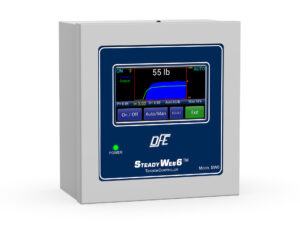
Closed-loop control measures actual tension instead of estimating it. The wire wraps over a roller on a tension transducer, such as a TriWheel™ Tension Load Cell, VNW Tension Transducer or Low Tension Transducer. The load cell converts that force into a signal.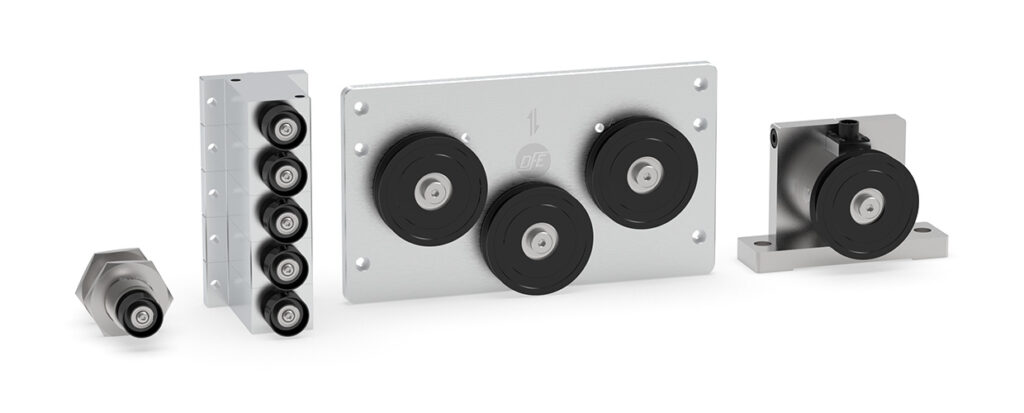 A controller such as the SteadyWeb™ 6 Digital Tension Controller compares the measured tension with the setpoint and continuously adjusts the brake or drive to correct it. It compensates automatically as spools empty and fill and as speed changes.
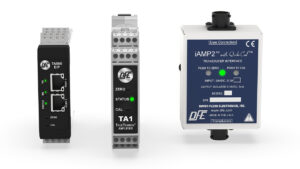
On lines run from a PLC, a load cell amplifier such as the TA1 or TA500 provides the tension signal to the PLC. The result: fewer breaks, consistent dimensions, better packages and less scrap.
SOLVE YOUR WIRE AND CABLE TENSION PROBLEMS
For more than 50 years, Dover Flexo Electronics has helped manufacturers and machine builders solve demanding tension applications. Tell us where tension is costing you yield. Complete the form below, call (603)332-6150 or email [email protected] to talk with an applications engineer today.
Not sure what your tension setpoint should be? Try the DFE Wire & Cable Tension Calculator.