
In web converting, two of the most frequently misunderstood technologies are tension control and web guiding. Both are essential. Both affect product quality. Yet they solve fundamentally different problems. The simplest distinction is this:
Tension control manages forces within the web.
Web guiding manages position of the web.
Many troubleshooting efforts become difficult because symptoms often overlap. A wrinkle may appear to be a tracking problem when it is actually a tension problem. Likewise, a web that wanders across the machine may cause wrinkles that operators mistakenly attribute to tension variations.
The key to successful troubleshooting is understanding which technology addresses the root cause.
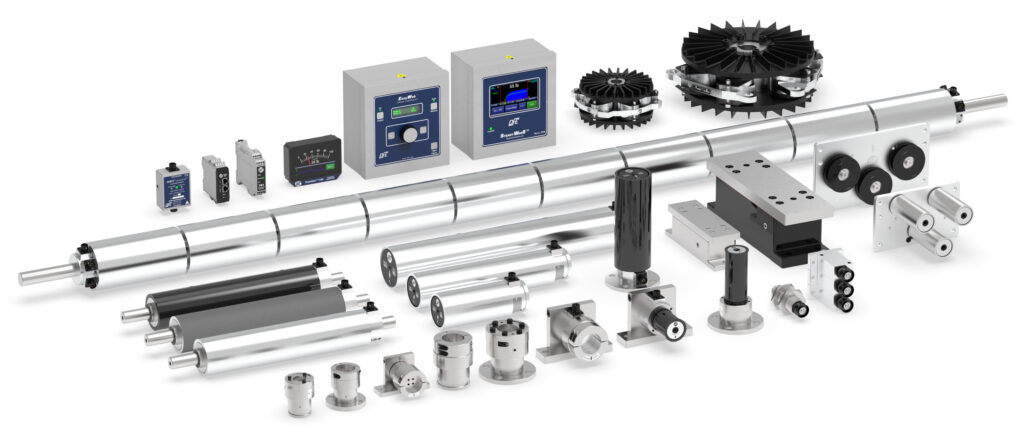
Tension Controllers, Load Cells and Brakes Manufactured by DFE
WHAT PROBLEMS DOES TENSION CONTROL SOLVE?
Tension control regulates the pulling force applied to a web as it moves through the process. The objective is to maintain stable strain in the material despite changes in roll diameter, speed, inertia, friction, and other machine dynamics. Poor tension control commonly causes:
Wrinkles and Buckles
When tension is too low, the web may not remain sufficiently taut to stay flat. Slack areas can form wrinkles as the web passes over rolls or enters winding zones.
When tension is too high, certain materials may buckle, neck, or distort, creating another form of wrinkle.
Stretch Variations
Elastic materials such as films, nonwovens, and some laminates can experience dimensional changes when tension fluctuates. Symptoms include:
• Registration drift
• Print distortion
• Variable product dimensions
• Difficulty maintaining process alignment
Roll Winding Defects
Many winding defects originate from improper tension management:
• Telescoping rolls
• Star defects
• Core crush
• Cinching
• Interlayer slippage
• Loose rolls
• Out-of-round rolls
These defects occur because tension determines how much force is stored inside the wound roll structure.
Web Breaks
Excessive tension remains one of the most common causes of web breaks. The web simply encounters a force greater than its available strength.
Unstable Processes
Coating, laminating, printing, and slitting processes often require consistent material strain. Even small tension variations can generate quality defects that appear unrelated to tension at first glance.
WHAT PROBLEMS DOES WEB GUIDING SOLVE?
Web guides do not control tension. They control web position. A guiding system continuously measures the lateral position of the web and makes corrections to keep the web aligned with a desired reference location. Typical web guiding applications address:
Edge Wandering
The web may drift from side to side because of:
• Roll misalignment
• Uneven unwind conditions
• Material shape variations
• Machine geometry issues
The guide compensates by repositioning the web.
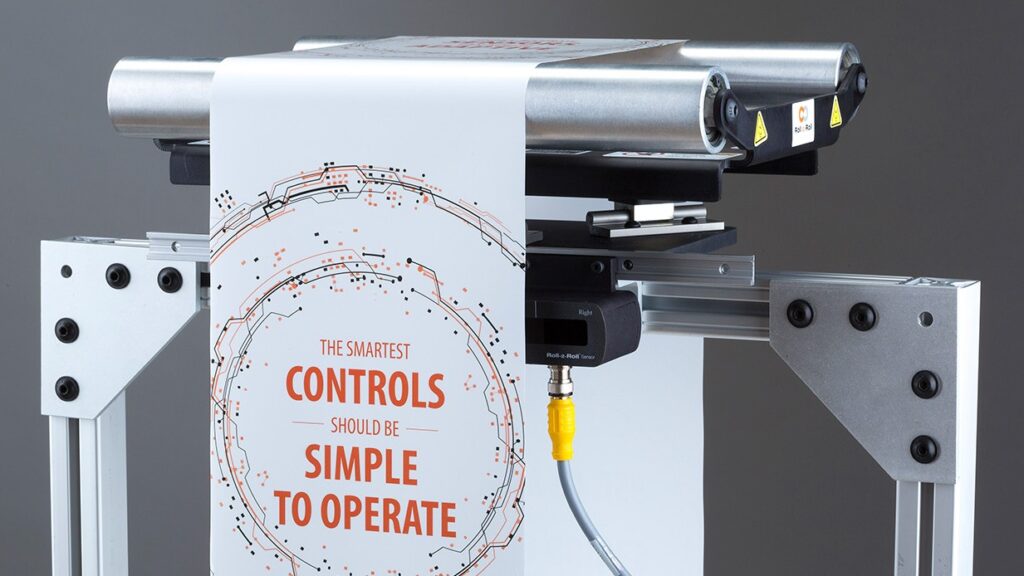 Web Guiding System Manufactured by Roll-2-Roll Technologies LLC
Registration with Downstream Equipment
Many converting operations require the web entering a process to maintain a consistent lateral position. Examples include:
• Slitters
• Printers
• Laminators
• Coating stations
• Die cutters
Without proper guiding, the process may gradually move off target.
Trim and Slitting Defects
A wandering web creates width variations and misplaced slit patterns. Proper guiding ensures the web stays positioned relative to knives, scores, or trim systems.
Material Utilization Problems
If the web drifts, operators often widen trim margins as insurance. Improved guiding reduces waste by improving positional accuracy.
WHAT PROBLEMS CANNOT BE FIXED WITH A WEB GUIDE?
This is where many troubleshooting efforts go astray. A web guide cannot cure:
• Telescoping rolls
• Core crush
• Loose winding
• Excessive stretch
• Web breaks caused by overtension
• Poor tension profiles
• Tension oscillation
A guide may keep the edge perfectly aligned while the winding tension continues producing defective rolls.
The web may be straight, but it is still being wound incorrectly.
WHAT PROBLEMS CANNOT BE FIXED WITH MORE TENSION?
The opposite mistake is equally common. Increasing tension typically will not correct:
• Persistent side wandering
• Misaligned slit patterns
• Poor edge positioning
• Roll alignment errors
• Lateral registration problems
In fact, higher tension may temporarily mask the symptoms while creating new problems such as stretch, wrinkles, roll defects, or breaks.
WHEN BOTH SYSTEMS ARE REQUIRED
The reality is that many converting problems involve both tension and position control.
Consider a laminator.
If tension is unstable, the web may stretch unevenly and create wrinkles.
If lateral position is unstable, the laminating nip may not remain properly aligned.
Neither system alone can solve the entire problem. Similarly, a slitter may require:
• Stable tension to produce quality rolls
• Accurate guiding to maintain knife-to-web position
These systems complement one another rather than compete with one another.
A Practical Troubleshooting Rule
When diagnosing a problem, ask one simple question: Is the defect related to web force or web position?
If the defect involves stretch, winding quality, breaking strength, slackness, or strain, investigate tension.
If the defect involves side-to-side movement, edge location, registration, or slit placement, investigate guiding.
If both force and position appear involved, evaluate both systems simultaneously because secondary symptoms frequently obscure the true root cause.
FINAL THOUGHTS
The most successful converters recognize that tension control and web guiding perform different jobs. Tension control governs what happens within the web. Web guiding governs where the web is located.
When troubleshooting, the goal is not simply to identify the visible defect. The goal is to determine whether the defect originates from force, position, or a combination of both. Once that distinction is made, the corrective action becomes much more obvious, and scrap reduction follows naturally.
As is said in web handling, a guide can move the web, and a tension controller can pull the web, but neither can do the other’s job. Understanding that difference is often the first step toward solving the problem.
Need Help Solving a Web Handling Problem?
For more than 50 years, Dover Flexo Electronics has helped converters solve force-related problems through precision tension measurement and control. From winding defects and wrinkles to stretch control and web break reduction, DFE specializes in helping customers achieve stable and repeatable web tension.
When the challenge involves web position, tracking, or alignment, DFE works with industry-leading partners in web guiding and position sensing to deliver holistic solutions that achieve fantastic web handling results.