If you work in medical and pharmaceutical converting, you are not just making product. You are managing a procession of delicate, expensive and often multilayer webs through coating, laminating, printing, slitting, die cutting and winding operations. That means this market is not merely a packaging or coating problem. It is, first and foremost, a web handling problem.
The mistake many processors make is assuming that if the line is running, tension must be acceptable. That is not how webs work. A web can run and still be stretching, wrinkling, wandering, misregistering or quietly building a lousy roll that will fail downstream. DFE’s Web Tension Control article makes the point plainly: proper tension must be maintained to prevent stretching, wrinkling, breaking and inconsistent registration, while improving coating uniformity, lamination quality and rewind quality. DFE’s Better Web Process Control Through Tension Sensing article describes it even more bluntly: inadequate tension control is the number one cause of material processing mishaps.
Medical and pharmaceutical products often use soft films, foils, papers, nonwovens, adhesive constructions and laminate stacks. These materials are less forgiving than many commodity webs. Their acceptable tension window is usually narrow. Too little tension and they bag, wrinkle, wander and misfeed. Too much and they neck, stretch, distort, curl, delaminate or wind poorly. In this market, “almost right” is often still wrong.
WHERE TENSION CONTROL PAYS BACK BIG
Medical and pharmaceutical converting involves processes integral to the following products –
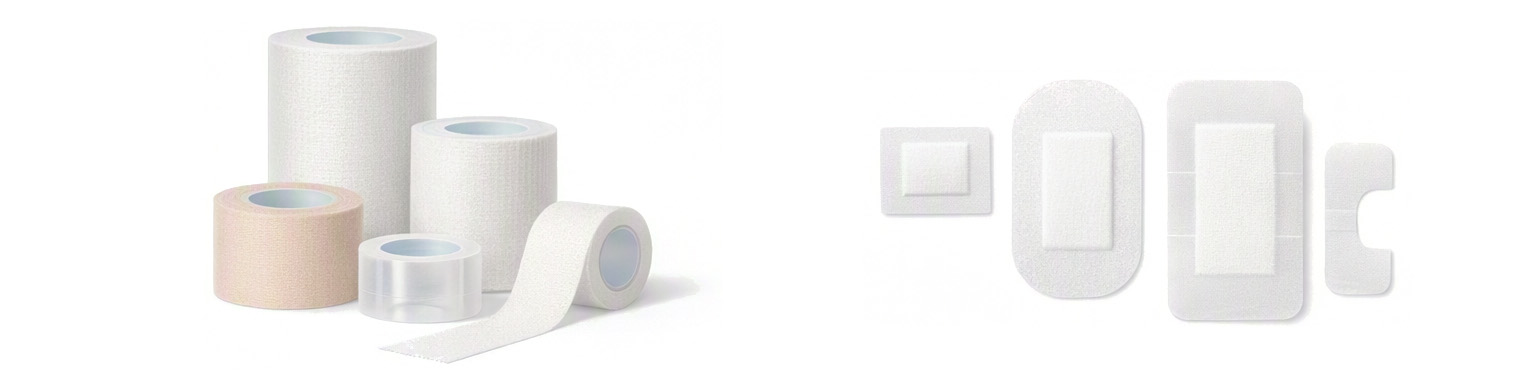
Medical Tapes and Wound-Care Constructions
These products commonly involve adhesive coating, lamination, slitting and die cutting. If tension drifts, the web may wrinkle into the coating zone, distort through laminating nips or lose position in die cutting. The result is poor coating laydown, trapped air, nonuniform lamination, edge defects and dimensional variation in the finished product. DFE’s Web Coating Tension Control article notes that stable tension is essential for flat web transport, uniform coating application and reliable adhesion, while the Rotary Die Cutting Tension Control article explains that steady web tension improves feed uniformity and cut precision.

Transdermal Patches and Multilayer Adhesive Assemblies
Patches are classic examples of a product that looks simple until you try to make it well. You may have a release liner, coated adhesive, active layer, backing layer and die-cut geometry all depending on stable strain history. If tension varies from unwind to lamination to die cut, the layers no longer behave like the same web. Registration shifts. Die cuts move. Laminates trap defects. Tension control by zone is critical here because what works at unwind will not necessarily be correct in the coating or laminating span, nor at rewind. DFE’s Web Tension Control By Zone article explains in more depth the need to isolate unwind, intermediate and rewind zones so each section can run at the proper tension rather than one compromise tension everywhere.
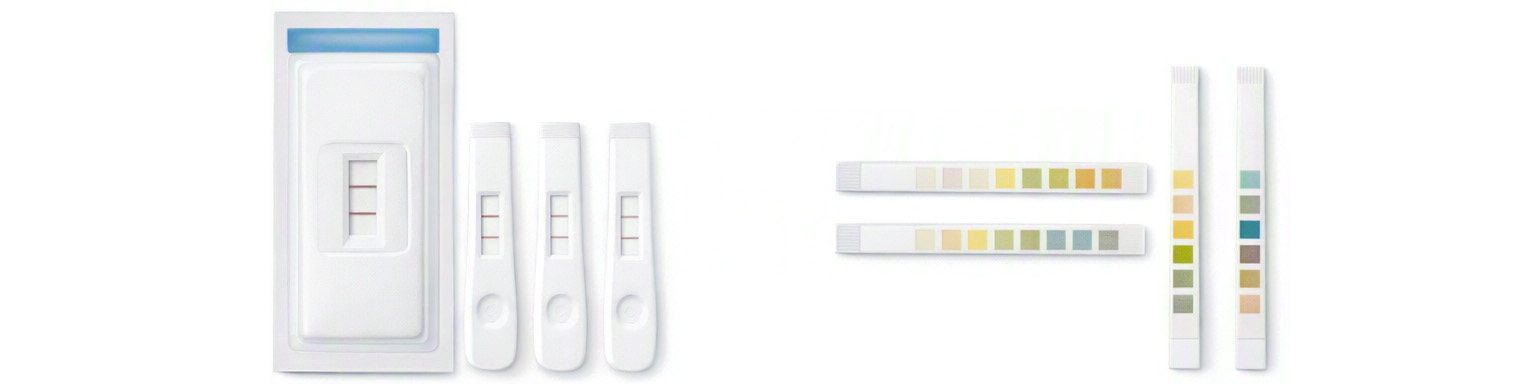
Diagnostic Test Strips and Narrow-Web Sensor Materials
These are narrow, high-value webs where even small lateral instability or tension variation can corrupt registration, slit quality or later assembly. DFE’s Narrow Web Tension Control article makes the key point: high-performance load cells allow accurate measurement regardless of web position, improving tracking and giving better control on narrow processes. For diagnostic strips, that means better lane stability, less wandering into slitting or die cutting and fewer subtle dimensional errors that show up as yield loss later.
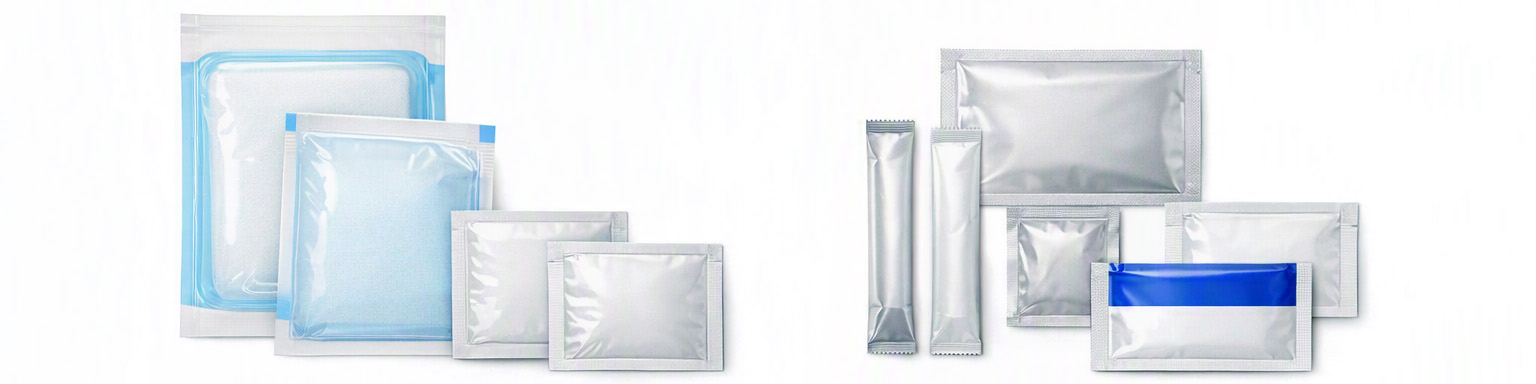
Sterile Medical Pouches and Pharmaceutical Sachet-Style Structures
Whether you call them pouches, lidding constructions or sterile barrier webs, these are converted multilayer materials. They often pass through printing, lamination, slitting and pouch-converting steps including folding, punching, sealing and die cutting. DFE’s Flexible Packaging Tension Control article points out that these interim steps all benefit from stability in web tension because stable tension improves tracking, registration and positioning throughout converting. The same logic applies directly to sterile and pharmaceutical package structures: if the web does not behave predictably, the package will not either.

Blister Lidding, Foil-Based Pharma Webs and Other Delicate Laminate Constructions
Foils and thin laminates do not tolerate poor tension management. Too little tension and the web can flutter, wrinkle or misregister. Too much and you stretch, crease or permanently damage thin layers. DFE’s coating and web tension resources both emphasize that tension is a prerequisite for uniform coating, predictable transport and stable processing. In other words, if a foil laminate seems “temperamental,” the first suspect should be tension, not operator temperament.
WHAT PROBLEMS TENSION CONTROL ACTUALLY SOLVES
Let us now get practical. Tension control is not a fashionable accessory, it solves specific problems.
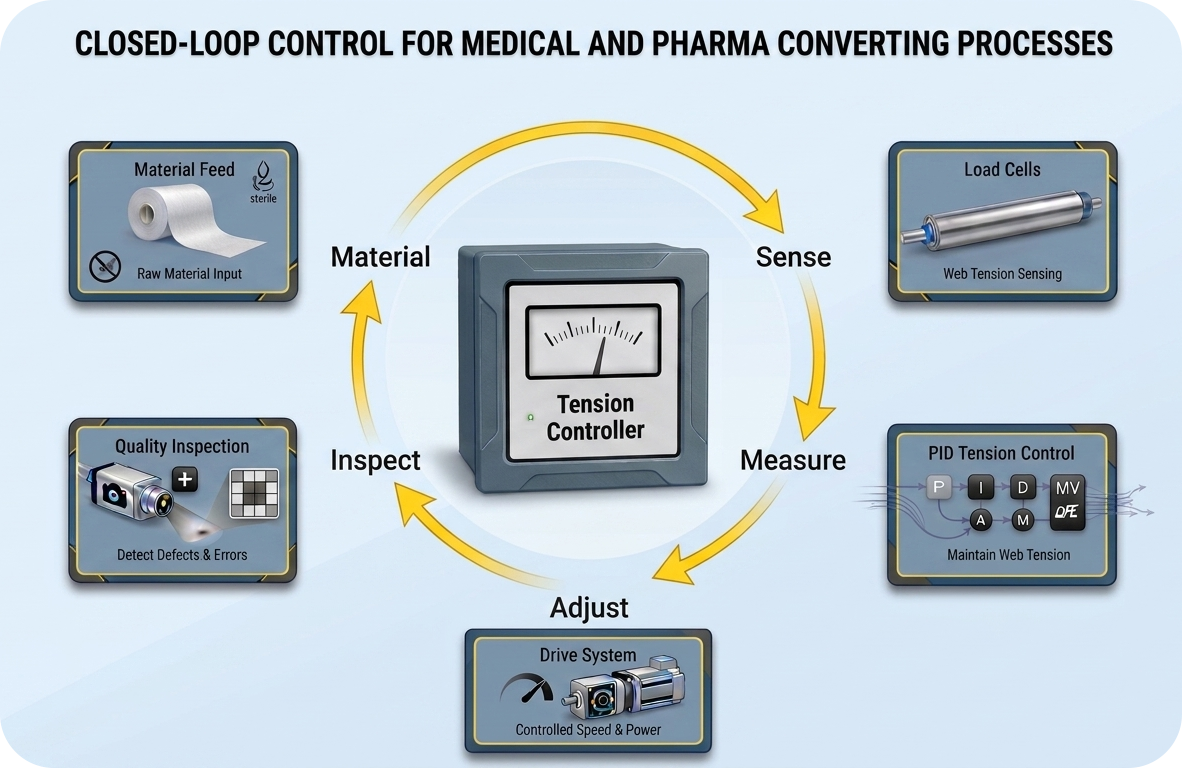
First, it reduces wrinkles, web breaks and intermittent misfeeds. Closed-loop control uses real tension feedback from load cells so the system can correct for roll diameter changes, acceleration, deceleration and ordinary process disturbances. That is far superior to guessing, manually trimming or assuming that a fixed brake setting will somehow remain correct as the roll shrinks. Closed-loop control maintains an actual setpoint using tension feedback rather than an approximate value, ensuring process consistency.
Second, it improves coating and lamination quality. A coating head cannot deliver a stable laydown to an unstable web. Likewise, laminating nips cannot combine layers uniformly if one layer is slack and the other is stretched. Poor tension makes it nearly impossible to maintain a steady speed and laydown rate through the coating zone, leading to thickness variation, adhesion problems and added waste.
Third, it improves die-cut accuracy and registration. Stable tension minimizes stretching, tearing and distortion, while improving feed consistency and reducing jams, wrap-ups and misfeeds. That matters greatly in medical products where geometry and repeatability are not optional.
Fourth, it produces better slit rolls and better finished rolls. That seems mundane until a poor roll shows up at the next operation and everyone pretends the problem started there. The common results of poor tension control are telescoping, crushed cores, wrinkles, overlapping, out-of-round rolls and poor unwind behavior. Those are not mere cosmetic defects, they are stored process errors.
Finally, tension control improves consistency from job to job. Medical and pharmaceutical converters do not make money rediscovering the right settings every shift. Closed-loop systems improve speed, quality and repeatability while reducing scrap and downtime. In short, measurement replaces folklore.
THE REAL LESSON
Medical and pharmaceutical converting is often described as a coating challenge, an adhesive challenge or a packaging challenge. Those descriptions are incomplete. It is also a tension challenge. If you do not control web tension through unwind, process and rewind zones, then every downstream operation is forced to work around an unstable foundation. That is a poor bargain in any converting line, and an especially poor one when the webs are narrow, delicate, expensive and quality-critical.
The takeaway is simple. In medical and pharmaceutical converting, tension control helps solve the problems people usually complain about—wrinkles, registration drift, coating variation, die-cut instability, roll defects, scrap and downtime. But it also solves the more important problem: unpredictability. And that is the defect that causes the most trouble of all.
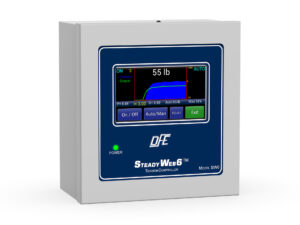
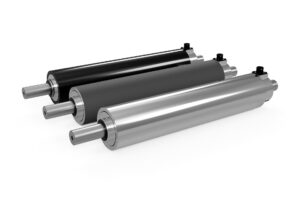
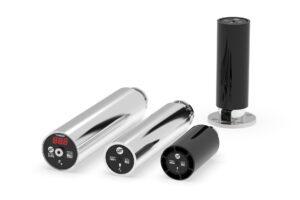
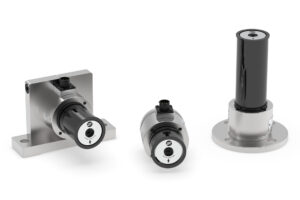
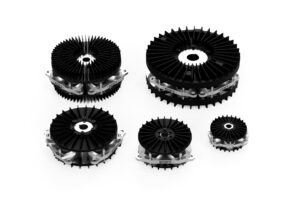
A typical DFE tension control solution includes a closed-loop controller (e.g., SteadyWeb 6™), a load cell (e.g., Tension Roll® or Model C transducer), and a brake or motor drive system. These components work together to deliver precise, repeatable tension, complementing the unique properties of medical and pharmaceutical applications.
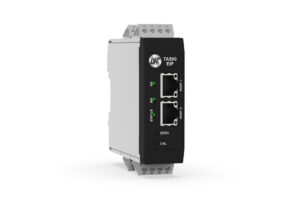
For manufacturers integrating with PLCs, DFE offers tension amplifiers with analog or ethernet connectivity, such as the TA1 and TA500, enabling seamless data collection and process monitoring.